 SHORNAS BLOG
What Is AI? Artificial Intelligence Explained in Simple Words
What is artificial intelligence? A simple explanation of how AI works, where you already use it, its benefits and risks, and how beginners can start learning about it.
You hear about AI everywhere: in the news, on your phone, at work and in school. But what does artificial intelligence really mean? Is it a robot, a super-smart brain or just software? This guide explains AI in simple words, without technical language, so anyone can understand it.
What is AI?
AI stands for artificial intelligence. It means computer systems that can perform tasks that normally need human intelligence, such as understanding language, recognizing pictures, making predictions or making decisions. AI does not think or feel like a human. It uses data and mathematics to find patterns and produce useful results.
A simple way to understand it
Imagine teaching a child to recognize cats by showing thousands of pictures and saying "cat" or "not cat." After enough examples, the child learns what a cat looks like. Many AI systems learn in a similar way. They are shown huge amounts of examples, find patterns and then use those patterns on new things they have never seen.
How does AI learn?
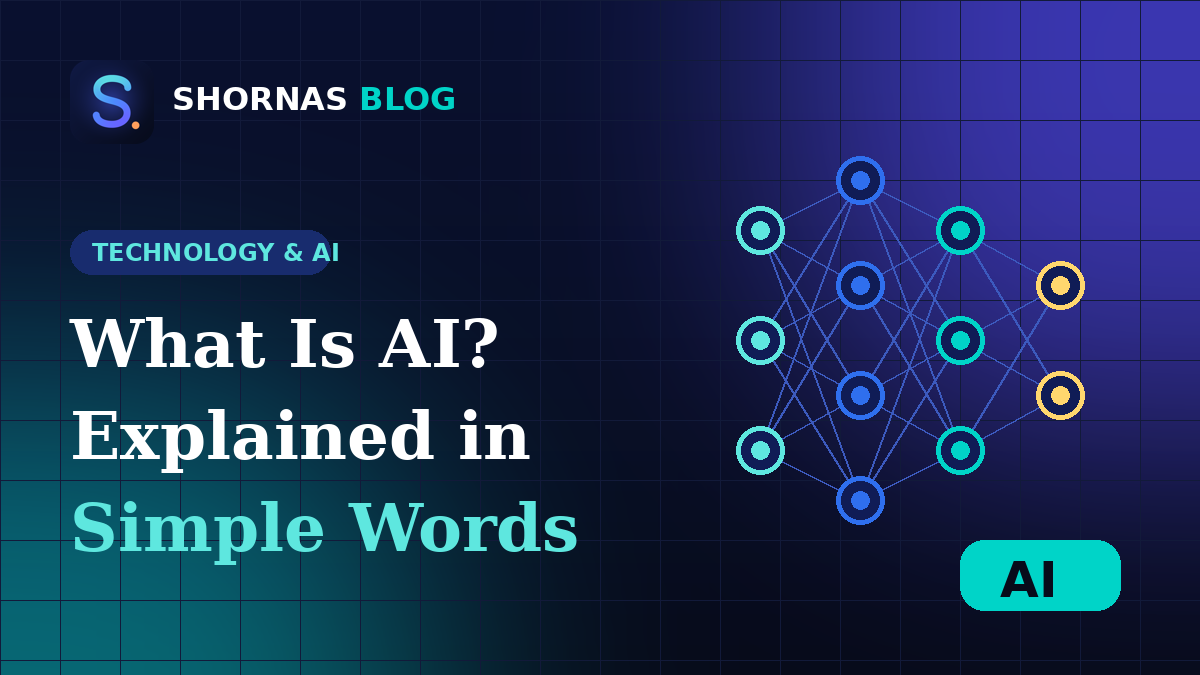
Most modern AI uses a method called machine learning. Instead of a programmer writing every rule, the system studies data and builds its own rules. The more good-quality data it learns from, the better it can become at its task. A popular kind of machine learning uses structures called neural networks, which are loosely inspired by how the brain connects cells.
Types of AI
Narrow AI: designed for one task, such as recommending videos, translating text or recognizing faces. Almost all AI today is narrow.
Generative AI: creates new content such as text, images, audio or code. AI chatbots and image tools are examples.
General AI: a system with human-level thinking across many areas. This is still a goal for research, and it does not exist today.
Where you already use AI
Phones: voice assistants, camera enhancements and keyboard predictions.
Social media and video apps: recommendations for what to watch next.
Online shopping: product suggestions and fraud detection.
Maps and navigation: traffic predictions and route suggestions.
Email: spam filters and smart replies.
Customer support: chatbots that answer common questions.
You may use AI many times a day without noticing it.
What AI is good at
Handling repetitive tasks quickly.
Finding patterns in large amounts of data.
Summarizing, translating and drafting text.
Helping people brainstorm and learn.
Assisting doctors, scientists and engineers with analysis, while humans make the final decisions.
What AI is not good at
AI can make mistakes and sometimes states false things confidently. It may reflect biases from the data it learned from. It does not truly understand the world the way people do, and it lacks human experience, emotions and responsibility. That is why human checking is important.
Benefits of AI
Saves time on routine tasks.
Improves access to information, such as translation and learning tools.
Supports better decisions by analyzing data.
Creates new opportunities and new kinds of jobs.
Risks and concerns
Misinformation: AI can produce fake or misleading content, including realistic fake images and voices.
Privacy: sharing personal data with AI tools can be risky.
Bias and fairness: AI can treat groups of people unfairly if its data is biased.
Jobs: some tasks may be automated, so people need to keep learning new skills.
Over-reliance: depending on AI too much can weaken your own thinking and skills.
Common myths about AI
"AI is always right." It is not. Always verify important facts.
"AI is a conscious being." Today's AI does not have feelings or awareness.
"AI will take every job." It will change many jobs, but human skills such as judgment, creativity and care remain valuable.
"Only experts can use AI." Many AI tools are made for everyday users.
How to start using AI safely
1. Start with a trusted AI chatbot and ask simple questions.
2. Learn how to write clear instructions, called prompts. Our guide on how to write better AI prompts can help, and you can explore prompt collections at Shornas Ai.
3. Do not share passwords, bank details or private documents.
4. Check important facts with reliable sources.
5. Follow the rules of your school or workplace.
To go deeper, read our guides on how AI chatbots work and how to use ChatGPT. You can also see practical ideas in ways to use AI to save time.
Skills worth learning in the age of AI
Critical thinking: question and verify what you read.
Clear communication: explaining what you want, to people and to AI.
Creativity and problem solving.
Digital safety: protecting your accounts and data.
Willingness to keep learning.
Final thoughts
AI is a powerful tool that learns patterns from data to help with tasks like writing, translating, recommending and predicting. It is not magic and not perfect. If you learn the basics, use it carefully and keep thinking for yourself, AI can become a helpful assistant instead of something to fear.

Comments (0)