 SHORNAS BLOG
CPM, CPC and CPA explained in plain English, with simple examples, formulas and a quick guide to help you choose the right ad pricing model.
CPM, CPC and CPA explained in plain English, with simple examples, formulas and a quick guide to help you choose the right ad pricing model.
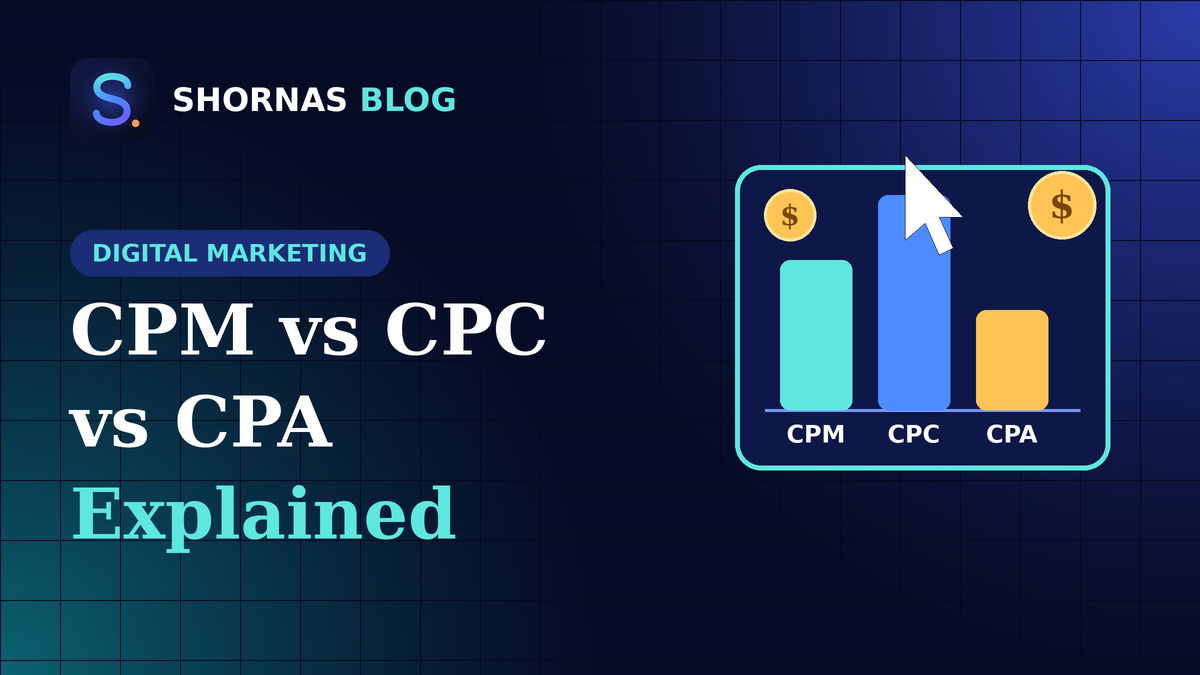
If you have ever looked at an advertising dashboard, you have probably seen three short words: CPM, CPC and CPA. They look like jargon, but each one answers a simple question: what exactly are you paying for?
Whether you are running ads for your business or earning money by showing ads on your own website, understanding these terms helps you avoid wasting money and compare offers fairly. This guide explains all three with easy examples.
The Quick Answer
| Model | You pay for | Who takes the risk | Best for |
|---|---|---|---|
| CPM | Every 1,000 times the ad is shown | The advertiser | Getting your name seen |
| CPC | Each click on the ad | Shared | Bringing visitors to a page |
| CPA | Each sale, signup or install | The publisher or ad network | Direct results |
What Is CPM?
CPM means cost per mille, and "mille" is Latin for one thousand. You pay a fixed price for every 1,000 impressions, which is the number of times your ad appears on a screen. It does not matter whether anyone clicks.
Formula: CPM = (Total cost ÷ Impressions) × 1,000
Example: If the CPM is $5 and your ad is shown 20,000 times, you pay 20 × $5 = $100.
CPM works well when the goal is awareness, such as announcing a new brand or app. The risk is that you pay even if nobody is interested.
What Is CPC?
CPC means cost per click. You pay only when someone actually clicks your ad. Showing the ad is free.
Formula: CPC = Total cost ÷ Number of clicks
Example: If each click costs $0.25 and you get 400 clicks, you pay 400 × $0.25 = $100.
CPC is popular because you pay for real interest. But a click is not a sale. A person can click and leave straight away, so a good landing page matters just as much as the ad.
What Is CPA?
CPA means cost per action (also called cost per acquisition). The "action" is something specific you choose: a purchase, a form signup, an app install or a free trial. You pay only when it happens.
Formula: CPA = Total cost ÷ Number of actions
Example: If you spend $100 and get 5 sales, your CPA is $100 ÷ 5 = $20 per sale.
CPA feels safest for advertisers because you pay for results. The catch is that publishers and networks carry the risk, so they often ask for a higher price per action, and not every site wants this kind of deal. It is closely related to affiliate marketing, where partners earn a commission for each sale they bring.
One Budget, Three Ways
Here is the same $100 spent under each model. The numbers are examples only, and real prices change by country, topic and platform.
- CPM: 20,000 views for $100
- CPC: 400 clicks for $100
- CPA: 5 sales for $100
None of these is "cheaper" on its own. What matters is which one gets you closer to your goal.
How to Choose the Right Model
- Want people to know you exist? Choose CPM.
- Want visitors on your website? Choose CPC.
- Want sales, signups or installs only? Choose CPA, if the platform offers it.
- Just starting out? CPC is a good beginner choice because it is easy to understand and control.
If You Own a Website: Learn eCPM and RPM
Publishers are paid in different ways, so comparing offers can be confusing. Two terms help:
- eCPM shows how much you earn for every 1,000 ad impressions, whichever payment model was used.
- RPM shows how much you earn for every 1,000 page views.
You can turn a CPC deal into eCPM with this formula: eCPM = CPC × CTR × 1,000, where CTR (click-through rate) is clicks divided by impressions, written as a decimal.
Example: A $0.25 CPC with a 1% CTR (0.01) gives 0.25 × 0.01 × 1,000 = $2.50 eCPM. Now you can compare it fairly with a CPM offer.
Common Mistakes to Avoid
- Judging only by price. A cheap click that never buys is expensive.
- Ignoring quality. Clicks from the wrong audience or accidental clicks waste money.
- Not tracking results. Without tracking you cannot know your real CPA.
- Changing too many things at once. Test one change at a time.
Frequently Asked Questions
Is a higher CPM always better?
Not always. For a publisher, a higher CPM means more earnings per 1,000 views. For an advertiser, it means paying more, which is only worth it if the audience is right.
What are CPI and CPL?
CPI is cost per install, used for mobile apps. CPL is cost per lead, such as a contact form. Both are types of CPA.
Which model is best for beginners?
CPC is usually the easiest to start with, because you pay only for visitors and can see results quickly.
Final Thoughts
CPM is about views, CPC is about clicks and CPA is about results. Pick the model that matches your goal, track your numbers and adjust slowly.
New to the basics? Start with our guide to what online advertising is. If you own a website, app or Telegram channel and want to earn from ads, you can also explore Shornas Ads.


Comments (0)